


Advancing Country-led Pathways for Strengthening Community Health Programs Through Civil Service Systems
Jun 23, 2026
Abidjan, Côte d’Ivoire 1– 2 June 2026
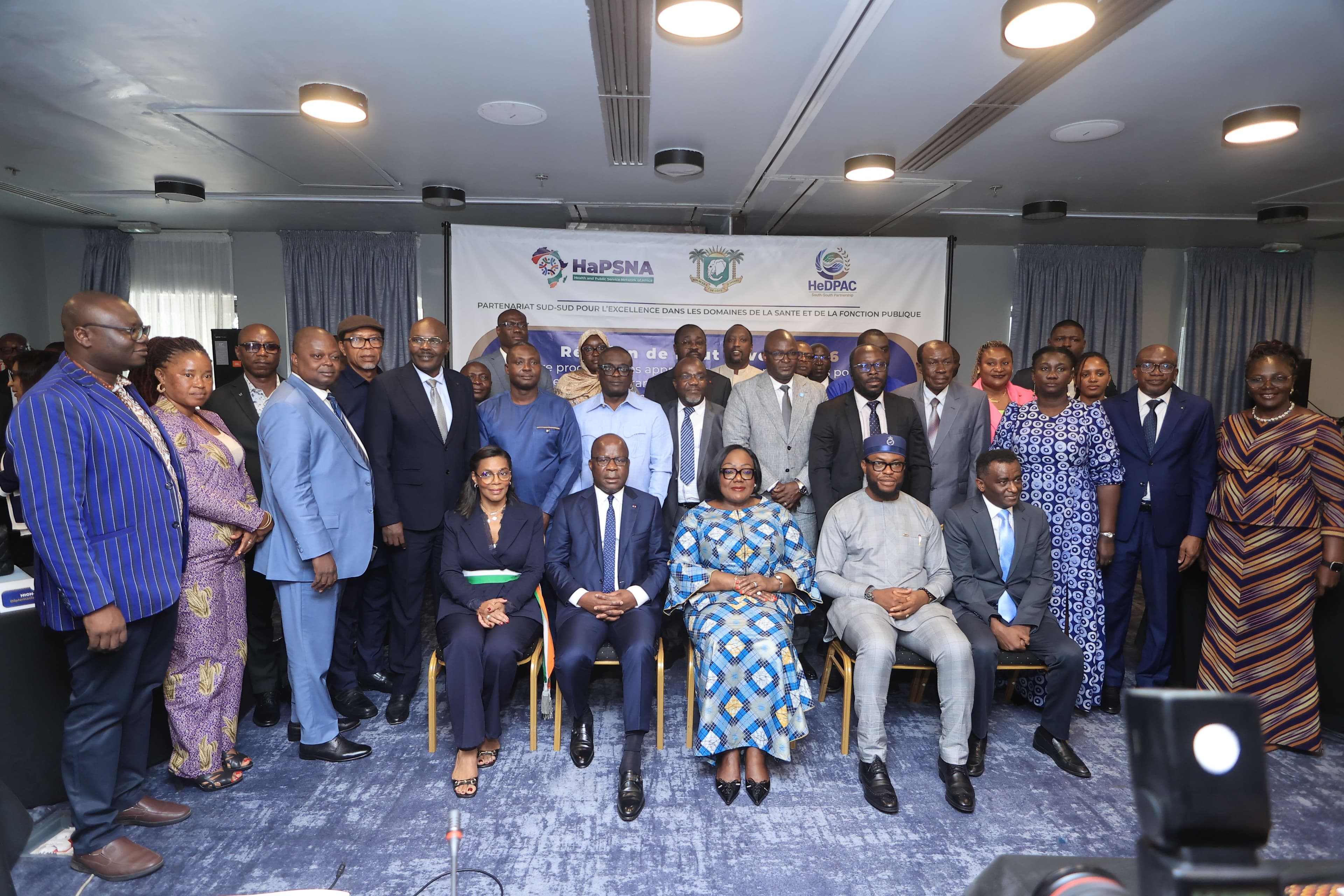
Senior government officials and technical experts from the Ministries of Health and the Ministries of Public Service of nine African countries convened in Abidjan, Côte d’Ivoire, for the Third Sitting of the Health and Public Service Network of Africa (HaPSNA) to advance country-led approaches to strengthening community health programs through civil service systems.
Hosted by the Government of Côte d’Ivoire, convened by the Republic of Liberia in its capacity as Chair of HaPSNA, and co-organized with the Health Development Partnership for Africa and the Caribbean (HeDPAC), the high-level meeting brought together delegations from across West Africa and beyond, including Benin, Côte d’Ivoire, The Gambia, Ghana, Liberia, Nigeria, Senegal, Sierra Leone, and the Central African Republic.
Building on previous HaPSNA engagements, the meeting focused on strengthening regional collaboration, institutional capacity, and South–South cooperation to address health workforce challenges and accelerate practical implementation pathways for stronger Community Health Programs (CHPs) and resilient public service systems.
Through technical discussions, country experience sharing, and peer exchange, participants explored practical reforms to strengthen governance, financing, workforce development, service delivery, monitoring systems, and institutional coordination across community health programs while advancing the professionalization and integration of Community Health Workers (CHWs) into national systems.
A major milestone of the meeting was the launch of two flagship technical tools developed through the HeDPAC–HaPSNA collaboration to support country-led community health reform.
The first, the Community Health Program (CHP) Maturity Framework, is a practical diagnostic, planning, and monitoring tool designed to support countries in assessing the maturity of their community health systems, identify priority reform areas, benchmark progress, and sequence implementation across key domains including governance, financing, workforce, service delivery, monitoring and evaluation, and health information systems.
Through an in-depth review conducted during the meeting, participating delegations explored how the Framework can support evidence-informed decision-making, strengthen institutional arrangements, and promote sustainable pathways for integrating Community Health Workers into civil service systems where applicable.
Complementing the Framework, the meeting introduced the Policy Package for Strengthening National Community Health Programs through Certified, Salaried, and Supplied Community Health Workers Integrated into Primary Health Care.
The Policy Package provides governments with strategic guidance to strengthen national community health systems through enabling policy, legal, institutional, and financing reforms while supporting the selection, training, certification, deployment, remuneration, supervision, and career development of CHWs.
Together, these tools offer countries a structured pathway to strengthen institutional arrangements, advance the professionalization and integration of CHWs, and accelerate progress toward resilient community health systems aligned with Primary Health Care (PHC), Universal Health Coverage (UHC), and South–South cooperation across Africa.
Opening the meeting, Madam Anne Désirée Ouloto-Lamizana, Minister of State, Minister of the Civil Service and Administrative Modernization of Côte d’Ivoire, reaffirmed the country’s commitment to strengthening community health systems and advancing the integration of Community Health Workers.
“With 73% of our health facilities supported by community health workers, our challenge today is to deepen their integration into health systems, assess their impact, and ensure that the commitments made here in Abidjan deliver meaningful results for our communities.”— Madam Anne Désirée Ouloto-Lamizana
Mr. Pierre N’Gou Dimba, Minister of Health, Public Hygiene, and Universal Health Coverage of Côte d’Ivoire, highlighted HaPSNA as a strategic platform to strengthen collaboration between the health and public service sectors in addressing workforce challenges.
"Since 2021, Côte d'Ivoire has significantly expanded its health workforce, and we remain committed to accelerating this progress through stronger collaboration, sustained investment, and long-term system strengthening to meet our 2030 ambitions."— Mr. Pierre N'Gou Dimba
Chairing the meeting, Dr. Josiah F. Joekai Jr., Chairman of HaPSNA and Director General of the Civil Service Agency of Liberia, highlighted the evolution of HaPSNA from dialogue into implementation.
“HaPSNA has shown that Africa’s most pressing health and public service challenges cannot be addressed in isolation. What began as a platform for dialogue has evolved into a platform for action.”
As HaPSNA’s technical partner, HeDPAC continues to support countries through technical cooperation, policy development, and practical implementation tools that strengthen institutional arrangements and advance the professionalization and integration of Community Health Workers within national systems.
Country presentations and peer-learning exchanges demonstrated varying stages of progress across participating countries while highlighting common challenges, including sustainable financing, workforce management, coordination across institutions, and the need for stronger legal and policy frameworks.
The meeting concluded with countries identifying preliminary implementation pathways and committing to introducing the CHP Maturity Framework and Policy Package within national planning and community health strengthening processes.
Participants reaffirmed the importance of continued collaboration between Ministries of Health and Public Service institutions. They recognized HaPSNA as an important platform for sustained peer learning, technical exchange, and regional cooperation.
HaPSNA and HeDPAC further reiterated their commitment to supporting countries through ongoing knowledge exchange, technical collaboration, and regional dialogue to advance resilient community health systems and accelerate progress toward UHC across Africa.
Development partners, including UNICEF, MUSO, and FENOSCI, participated in support of this shared regional agenda.
Read the Full Meeting report: https://cdn.sanity.io/files/d58uahw5/production/adb196446f10a3134eabefcedd600fd99f3b5aa9.pdf